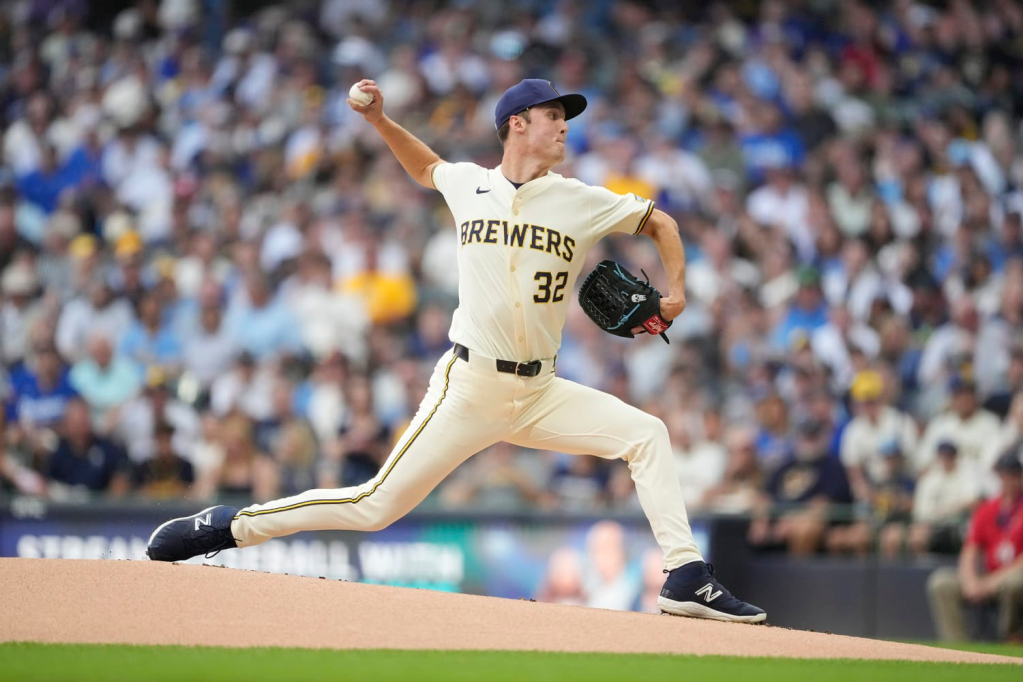
On June 12, 2025, a 6’7″, 197-pound right-hander from Blue Springs, Missouri stepped onto a major league mound for the first time. Less than a month later, Jacob Misiorowski was named an All-Star. His debut performance was electric: 5 no-hit innings on 86 pitches, 4 walks, 5 strikeouts and a 6-0 win.
When the 2025 All Star Game came around a month after his debut, he was suddenly thrust onto the NL roster as a replacement. Was the nod premature? Or is the baseball world recognizing something undeniable? Who is Jacob Misiorowski? And how did he end up in the 2025 All Star Game?
The Draft

A member of the 2020 high school recruiting class, Jacob Misiorowski missed out on an impactful time in any baseball prospect’s career due to COVID. He missed out on the ability to showcase his abilities in his senior spring season and to open the eyes of college and major-league scouts around the country.
Misiorowski was not drafted in the shortened 2020 Draft, despite drawing interest and almost getting selected by the Milwaukee Brewers. In fact, the Brewers were one of three teams (along with the Rays and the Rockies) to even send a scout to watch him throw a bullpen session in December 2019.
In 2020, Misiorowski enrolled at Crowder College, a JuCo in Missouri, where he was set to play a couple years of college baseball before either taking the leap to a bigger college program or to the minor leagues. Misiorowski sustained an injury to his meniscus that first year of JuCo, and it wasn’t until his sophomore year that he began to light up the radar gun, hitting triple digits on his fastball.
With a commitment to play at LSU the following year, Misiorowski was projected to hear his name called in the first few rounds of the 2022 MLB Draft. Sure enough, the Brewers, who had loved his potential since 2019, selected him in the second round (63rd overall) and signed him over-slot for $2.35 million, the highest of the Brewers’ draft class.
Minor Leagues

And so his journey through professional baseball would begin.
After throwing an ugly 1.2 IP in A-ball after getting drafted in 2022, Misiorowski began 2023 at the same level. And he pitched with a purpose.
In 9 starts at A-ball, Misiorowski threw 26.2 innings to a 3.04 ERA, allowing, 10 H, 9 ER and 12 BB, while striking out 46. He allowed 0 HR.
Taking a look under the hood: Miz threw to a 1.83 FIP (44 FIP-) and 2.52 xFIP, struck out an unthinkable 45.5% of batters, and held a 0.83 WHIP. He walked 11.9% of batters, but who noticed?
The Brewers promoted him to High-A (A+), where he made 6 starts (23.2 IP) to a 1.90 ERA, allowing 15 H, 5 ER and 14 BB, while striking out 28. Again, no HR given up.
He continued to show flashes with a 3.55 FIP (84 FIP-), a 26.4% K-rate and a solid 1.23 WHIP. However, a 4.80 xFIP and a continued red flag of a 13.2% walk-rate showed again.
A second promotion in 2023 brought him to Double-A, where he understandably struggled. What kind of pitcher would be able to handle 2 promotions in a single season without a little bit of a slump?
He made 5 starts (21.0 IP) with a 5.57 ERA, allowing 17 H, 13 ER, 2 HR and 16 BB, while striking out 36. A 5.25 FIP (107 FIP-), 5.36 xFIP, and 1.57 WHIP emphasized his struggles. Yet, he managed to strike out a third of the hitters he faced (33.6% K%), but raised his already-shaky walk-rate to 15.0%.
Miz began 2024 in AA and made 19 starts (79.2 IP) to a 3.50 ERA, allowing 52 H, 31 ER, 7 HR and 50 BB, while striking out 105 batters. On the surface, his numbers look alright. Under the hood, however, a 4.08 FIP (105 FIP-), 3.81 xFIP (103 xFIP-), and 14.4% BB% pointed to more difficulty out of the lanky right-hander. He was still striking out batters at an amazing rate (30.3% K%), likely pointing to a career in the bullpen if he was to make the majors, but his control remained a concern. He wasn’t improving on last year’s weakness.
A promotion in 2024 introduced him to Triple-A hitters: he made 14 appearances, starting twice, pitching 17.2 innings to a 2.55 ERA, allowing 5 H, 1 HR and 10 BB, while fanning 22. An 86 FIP- and 91 xFIP- combined with a 31.4% K-rate, 0.85 WHIP and career-best 48.6% groundball-rate proved to Milwaukee he was ready for the big leagues, despite his walk rate (14.4%), and despite it not being obvious whether he was a starter or reliever.
2025 saw him start the first couple months in AAA, making 12 starts (63.1 IP), posting a 2.13 ERA, allowing 38 H, 15 ER, 4 HR, and 31 BB, while sending 80 back to the dugout.
A fine 73 FIP-, 79 xFIP-, 31.6% K-rate and 1.09 WHIP was bolstered by a slightly-improved 12.3% walk-rate earned him his promotion in June.
Welcome to the Big Leagues
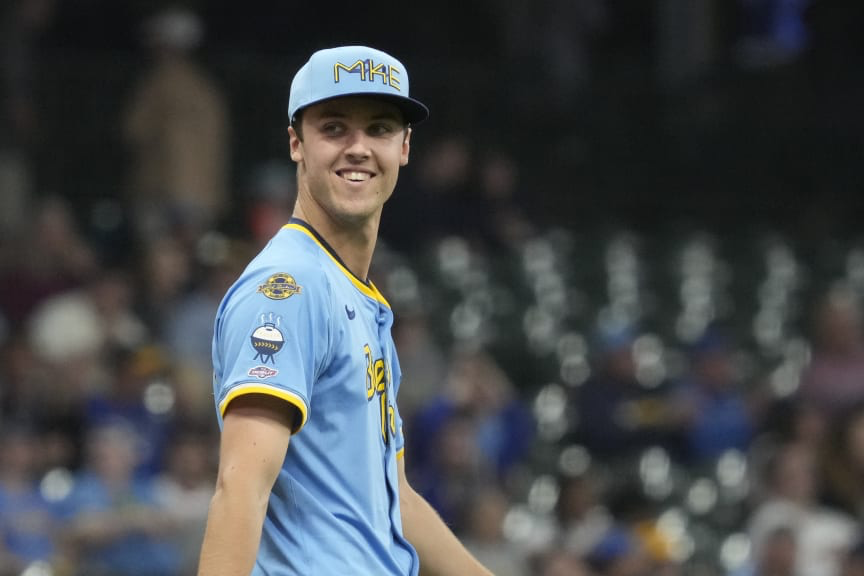
Called up on June 10, 2025, Miz made his MLB debut in a start against the St. Louis Cardinals two days later.
His first pitch in the big leagues? A 100.5 mph fastball. His second pitch in the big leagues? A 101.8 mph fastball. His fifth pitch in the big leagues? A 102.2 mph fastball.
He would throw 5 innings of no-hit baseball, walking 4 batters and striking 5 out. If it wasn’t for being forced out of the game with cramps he might’ve improved on those numbers.
He continued that dominance and his first 11 innings in the majors contained 0 hits.
His next start was a 6.0 inning, one-hit, 2 ER, 1 BB, 6 K outing. That hit was a home run.
Besides one ugly start against the Mets on July 2, Miz has been amazing. He even had a 12 K, 2 BB start against arguably the best lineup in baseball in the LA Dodgers.
So far, in 25.2 innings, Miz has put up a 2.81 ERA, allowing 12 H, 8 ER, 4 HR, and 11 BB, while K’ing 33. Even deeper, Miz has a 3.82 FIP (95 FIP-), 3.13 xFIP (78 xFIP-), 3.21 SIERA, 33.7% K-rate, 11.2% walk-rate (best of his pro career!) and a 0.90 WHIP. FanGraphs rates his Stuff+ at a 123. And to get even weirder, FanGraphs has hit botERA at 2.66!
I’m not gonna sit here and pretend I know exactly what botERA tells us, but I do know that it takes into account the characteristics of the pitch like the velocity, the spint rate and the location and ignores any resulting outcome. He’s making good pitches at good moments, and that is why I think he does deserve respect.
He’s currently got a .160 BABIP, though, suggesting the Miz will regress a bit after having tremendous success against balls in play (the Brewers have a great defense). He’s also been slightly vulnerable against lefties (1.42 WHIP, 4 HR against 53 batters faced).
The Doubters Do Have a Point
There are three main arguments from the general population against Jacob Misiorowski’s rise to stardom and selection to the All Star Game.
The first is that the sample size is so, so small. Baseball is notorious for needing large sample sizes to get a clear read on a player. For a hitter, hundreds of ABs are necessary to feel comfortable in an evaluation. For pitchers, hundreds of innings may be needed, depending on whether that pitcher is a starter or reliever. Misiorowski’s 25.2 innings is simply nothing compared to the amount of innings proven pitchers like Christopher Sanchez and Nick Pivetta (both of the NL not named as replacements) have put in this year alone.
The second argument is his walk rate. Sure, he strikes a lot of hitters out, but his walk rate is alarmingly high–and has been his whole professional career. Miz almost profiles as a back-end of the bullpen reliever because the walk rate could be seen as unsustainable once his BABIP inevitably evens out and he pays the price for it.
The last argument is not exactly against Miz–it’s against the MLB’s decision to select him as a replacement–and it’s that Miz is being displayed because of the hype as a sort of theatrical icon. Critics have said that the fact he lights up a radar gun was, in the MLB’s eyes, a spectacle that an audience couldn’t resist, and would therefore lead to higher viewership numbers for the Midsummer Classic. The fact that he would be chosen for this reason over sustained success is something that would be tough to get behind.
However, What He’s Doing is Undeniable
Misiorowski is unlike any pitcher in the big leagues right now, and that’s a fact.
According to Baseball Savant, he is in the 99th percentile in extension, meaning he releases the baseball from his hand closer to home plate than pretty much any other pitcher. Do you understand how fast a 100 mph fastball looks to a hitter when it comes in from 53 feet?
Misiorowski offers extreme deception on his pitches as well. His 30 degree arm slot releases the baseball around 5 feet above the ground, making it extremely difficult for pitchers to get a read on the pitch, if they can even see it at all.

Take a look to the right for Misiorowski’s movement profile from Baseball Savant. That grey line illustrates his 30-degree arm angle on his pitches. That white spot is where the ball leaves his hand.
He uses his 4-seam fastball (the red dots) 52% of the time, and rightfully so. He’s in the 99th percentile for fastball velocity, averaging 99.3 mph (~4.5 mph faster than the average righty). His fastball also rises almost 2 inches more than the average right-hander’s and makes that pitch borderline-impossible to square up.
On his fastball, his xBA is .154, xSLG is .260, and xwOBA is .222. Batters are whiffing on that pitch 27.6% of the time. Not to mention, he pairs this unbelievable fastball with 3 other pitches: a 94 mph slider, a 92 mph changeup, and an 87 mph curveball.
His curveball (the blue dots) is arguably more effective than his fastball at this point! It has an xBA of .164, an xSLG of .360 and an xwOBA of .218. Batters are whiffing 50% of the time he throws it and he’s putting hitters away with it 35.5% of the time.
I know I’m overwhelming you with numbers, but it’s for a reason: Misiorowski is the real deal. He’s extremely hard to hit, and that’s partly because of the way he’s built. He has a small sample size, yes, but let’s take a look at a comparison of his, Paul Skenes’ and Tarik Skubal’s rookie years in 2025, 2024 and 2020, respectively.
| Stat | Misiorowski | Skenes | Skubal |
|---|---|---|---|
| xBA | .180 | .192 | .222 |
| Chase% | 30.2% | 30.9% | 30.0% |
| Whiff% | 29.7% | 28.7% | 29.4% |
Skenes and Skubal are the two starters in the All Star Game this year, likely on their way to Cy Young Awards this year and in the future (in Skubal’s case, that’s already been realized). He’s right there with them–and arguably more electric.
The Verdict
Was Jacob Misiorowski’s All Star selection premature? I would say yes, probably.
Is it bad for baseball? Absolutely not.
He has the most “stop-what-you’re-doing-and-watch” stuff of any young arm in baseball. He throws a triple-digit fastball with ride and complements it with off-speed and breaking stuff that creates an arsenal that could be unmatched in the years to come.
Sure, the walk rate needs work. That can be fixed, though. The Brewers are known for their pitching development and have produced a Cy Young winner in Corbin Burner in 2021. They’ve developed guys like Brandon Woodruff, Freddy Peralta, and the aforementioned Burnes. With Misiorowski, the talent is too obvious to ignore.
This isn’t about what he’s done—it’s about what he is. And what he is, is baseball’s next must-watch ace.
 Inner Half