
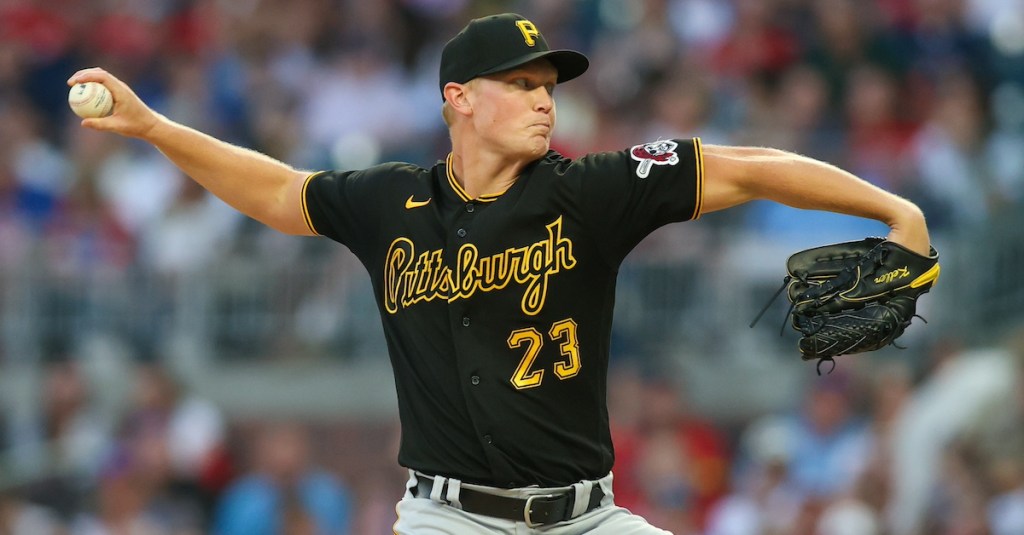
The starting pitcher market at the 2025 trading deadline does not boast any superstar names. Sandy Alcantara and Zac Gallen headline the group with a chance to be dealt at that position. Mitch Keller, a 29 year old righty with 3 years of control after 2025 presents one of the most intriguing cases on the board.
Mitch Keller, SP, PIT (2025, Age 29, Free Agent 2029) – 21 GS, 125.0 IP, 4-10 W-L, 3.53 ERA, 3.42 FIP, 1.16 WHIP, 6.98 K/9, 2.16 BB/9, 0.72 HR/9
At the time I’m writing this, the Pirates sit at 41-61. They are in last place in the NL Central, 19.5 games behind the Cubs and 14.5 games outside of the final wild card spot. Year in and year out the Pirates disappoint their fans and it seems like such a waste of pitching talent with Skenes and Keller.
Keller has started 21 games for the Pirates this season and pitched to a 4-10 record with a 3.53 ERA and 1.16 WHIP, both ranking in the top 30 among qualified starters. His 3.42 FIP ties him for 21st in the league with José Soriano of the Angels and his 84 FIP- is right there with guys like David Peterson of the Mets, Carlos Rodón of the Yankees and Dylan Cease of the Padres. If Keller pitched for a better team, I’m sure his win-loss record would look dazzling compared to what he’s got now.
Let’s first do our due diligence in Mitch Keller’s FanGraphs numbers.
Keller’s been walking hitters 5.8% of the time–the lowest rate of his career–at the expense of strikeouts, which still happen at a 18.7% clip, only a few ticks below his career average (21.9% K%). He’s throwing in the zone 57.6% of the time–more than he ever has–and hitters aren’t doing too much better in the contact department than you might think. Like I mentioned earlier, he’s got his WHIP sub-1.20 for the first time in his 7 seasons pitching at the big leagues, and his BABIP of .279 poses no reason to be concerned about regression at the moment.
Setting 2025 apart from his other seasons has been Keller’s ability to command the strike zone while continuing to limit home runs. He’s currently giving up 0.72 HR/9, the lowest rate at which he’s done so in his career and .28 lower than his career average of 1.00 HR/9. His line-drive rate is down to 18.8% from 23.8% in 2024 and his groundball-rate is up a few ticks to 44.8% from 39.4% the season prior. Though his fly-ball rate has been steady the last couple seasons around 36%, his HR/FB rate being down to 7.1% this season versus 11.0% over his career suggests there could be a hint of regression coming his way later this season in the form of home runs. For now though, he’s limiting the likelihood hitters will get on base against him with less walks and less line drives.
Keller’s abandoned his cutter this season after throwing it 12.2% of the time last season and almost a quarter of the time two seasons ago in favor of his slider and changeup to go along with his fastball, sinker, sweeper and curveball. 6 pitches is always going to pose a difficult challenge for opposing hitters, especially when he can throw any of them for strikes. FanGraphs credits his fastball with 10.1 runs above average (wFA) this year–easily the best it’s been over his career–and Baseball Savant backs that evaluation up.


Keller’s not going to overwhelm hitters with pure stuff, but it sure helps to have a fastball in the 97th percentile in terms of run value. Also, his ability to throw 6 pitches will always pose an issue for hitters who thrive on being able to guess what’s coming. He’s dropped his arm angle from about 50 degrees to his current 38 degrees in recent seasons, allowing his breaking stuff to get more movement, which can be seen in his sweeper’s horizontal break and his curveball’s devastating drop.
What stands out to me, again, is that walk rate because it makes the other apparent weaknesses in his game a lot less costly. Keeping baserunners to a minimum will always help the chances of the pitcher to keep runs off the board.
In Keller, a buying team gets a proven righty innings-eater with an ability to limit walks and limit runs. He’s no ace by any means, but his 2.6 fWAR and 2.5 RA9-WAR through 21 starts puts him right around a number 2 or above-average number 3 starter in any rotation. Plus, the trading team will have control through 2028 on a contract that, if he keeps performing as he has been, continues to look like an absolute bargain. Keep an eye out for any team in need of starting pitching this season and beyond–Keller should provide them with a reliable right arm that controls walks and home runs with the best of them.
 Inner Half