
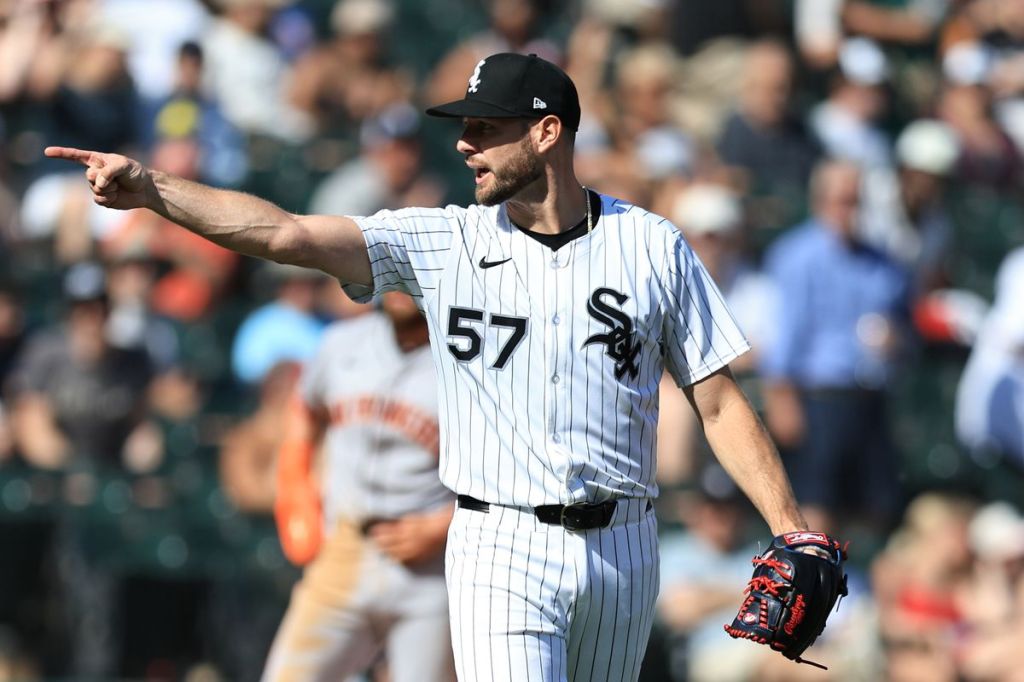
Unsigned until May 20 this season, Adrian Houser doesn’t scream “splash” free agent addition. In fact, the Chicago White Sox are only paying him a prorated $1.35M contract for this season. He had been pitching for the Rangers’ Triple-A affiliate before being released just five days before signing with the White Sox. That’s how desperate they were for an arm to fill in their rotation.
Houser pitched for the Mets last season, coming over in a trade with Tyrone Taylor from Milwaukee, making 23 appearances (7 starts) and pitching to a 5.84 ERA in 69.1 IP. He was DFAed and released from the team in July.
He made 8 starts in AAA Round Rock (TEX) earlier in 2025 with a 5.03 ERA in 39.1 IP. What made the White Sox want to sign him? Well, (1) Houser had 5 years of Major League experience under his belt, (2) the White Sox rotation flat-out stunk and (3) Houser has some qualities traits that can be sought-after in a big league arm.
Adrian Houser, SP, CWS (Age 32, FA after 2025) – 10 GS, 62.0 IP, 5-2 W-L, 1.89 ERA, 3.01 FIP, 1.23 WHIP, 6.39 K/9, 2.76 BB/9, 0.29 HR/9
With Houser dealing this season, the White Sox have stumbled upon a profitable trade chip they never saw coming. It’s not certain they’ll get much for him, but a top 30 prospect of another organization would surely be welcome with open arms.
A special 1.89 ERA seems impossible to accumulate after 10 starts with the lineup they field each and every day, but Houser has done so. He’s done so through mitigation of home runs. He’s currently giving up 0.29 home runs per nine innings (HR/9). His strikeout rate (17.7% K%) is right around his career average and he’s got his walk rate (BB%) down to 7.7%, a tick below his average. Walks, strikeouts and home runs are considered the outcomes in the pitcher’s control in the context of FIP, so his 3.01 FIP being higher than his 1.89 ERA shouldn’t concern potential buyers into avoiding him–he’s doing a really good job at limiting bad outcomes that are in his control.
Already a pitcher who’s limited fly balls over his career (28.0% FB% over 670+ IP), Houser’s home run-to-fly ball rate sits at 3.6%. Were he a qualified pitcher (1 IP per team game played), he would have the lowest HR/FB rate by 1.8% (ahead of Paul Skenes’ 5.4% HR/FB). For starting pitchers with at least 60 IP, he still has the lowest by 1% over Tyler Mahle. Houser could be due for some regression to the mean, which for his career sits around 11% (aligns with major-league mean of HR/FB). For the record, his xFIP stands at 3.91, meaning that if Houser pitched the way he’s currently pitching and gave up the amount of home runs he should have given up, his FIP would be expected to be 3.91. This doesn’t mean regression has to come this season. Houser will likely not be pitching an astounding number of innings for any team he goes to, so he could very well continue a strong HR/FB rate before his tenure with the buying team ends. It can take many, many innings for a pitcher to regress to the mean of anything.
Houser’s batting average on balls in play (BABIP) sits at .301, suggesting he hasn’t been benefitting from any luck or good defense and vice versa, he hasn’t been suffering from bad luck or bad defense. That doesn’t mean the White Sox have been good defensively. In fact, they sit at 23rd in the MLB in both outs above average (OAA) and defensive runs saved (DRS) with -16 in both categories.
Splits & Role Projection
In terms of splits, Houser, being a right-handed pitcher, is traditional in that he performs better versus right-handed batters than against left-handed batters. He’s given up both home runs he’s allowed this year to left-handed hitters and walks them 10.4% of the time, compared to walking righties 4.9% of the time. His .345 wOBA he allows lefties vastly outshines his .236 wOBA he allows to righties. His time-through-order (TTO) splits show that Houser’s first two times through an order (.284 wOBA and .267 wOBA, respectively) are much better than his third time through the order (.339 wOBA). What does this tell us? That Houser could be primed for a bullpen role wherever he’s traded, likely as a multi-inning reliever.
Pitch Profile


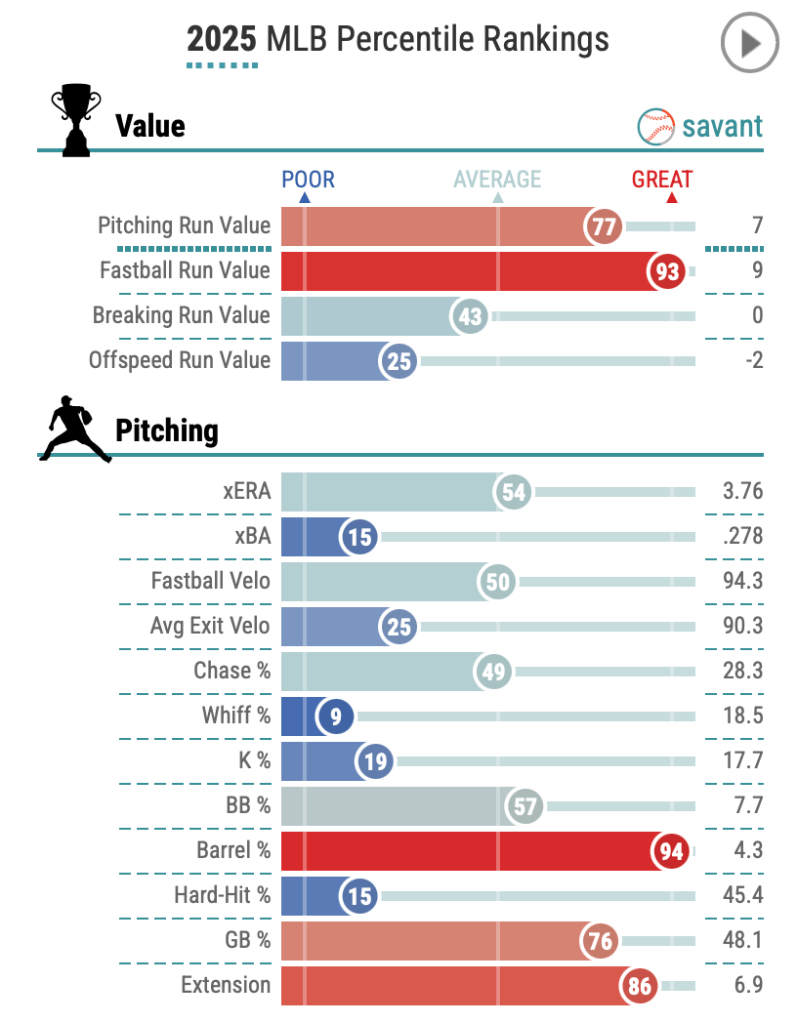
If you take a look at Houser’s Baseball Savant page, you’ll notice he throws five different pitches. As I mentioned in my Mitch Keller write-up, any pitcher throwing more pitches versus fewer is going to have an advantage against the hitter based on pure uncertainty from the guy with the bat in hand. He primarily throws that sinker (45% usage rate) and mixes in a curveball, changeup, 4-seam fastball and slider here and there. The sinker and changeup mirror each other in movement despite a 10 mph velocity gap, a tunneling advantage that likely plays a key role in deception. His changeup (39.4% Whiff%) and curveball (33.3% Whiff%) have quietly become real weapons.
He’s not going to dominate you with strikeouts (19th percentile in K%, 9th percentile Whiff%), but he limits fly balls and promotes groundballs (48.1% GB%, 76th percentile). With a fastball run value in the 93rd percentile with average velocity in the 50th percentile means Houser is sequencing and locating effectively.
Outlook at the Deadline
All in all, Adrian Houser’s not going to have a team giving up a top prospect, but he’s going to have his name brought up in discussions as a potential asset for a contending team. Keep an eye for his new role if a team does make a deal for him.
 Inner Half