The “99” in pinstripes and “17” in Dodger blue continue to prove they are two of the most legendary figures in not only baseball, but all of sport.
Aaron Judge just won his 3rd AL MVP after another incredible season in 2025, Shohei Ohtani his 4th NL MVP. Two of the premier sluggers the game has ever seen, these two defy what it means to perform at the plate in a 162-game season. Ohtani laughs at that simplicity and decides he needs to twirl triple-digits on the mound and embarrass the other team in more ways than one.
These two provide value to their respective big-market teams in similar ways. They’re leaders, sluggers, legends in the making. To demonstrate this narrative, I’ll do a dive into their respective MVP seasons, and why in the greater historical context, you need to realize that their names won’t be the answer to just obscure trivia questions, but common baseball knowledge.
Unprecedented dual-dominance
Every year there seems to be new nuggets of history created in all sports. This MLB season was no different. Judge and Ohtani are an unprecedented duo dominating their respective leagues. They became the first duo to win back-to-back MVPs in the same two years.
Even with Cal Raleigh breathing down his neck, Aaron Judge was able to prove to the Baseball Writers of America that there should be no mistake he’s still the most valuable. To beat out a 60-homer catcher in Raleigh, Judge solidified himself as the no-discussion-needed greatest player in the AL. With that being said, let’s start with New York Yankee Aaron Judge.
What is an MVP?
The Most Valuable Player is self-explanatory and present in basically all American sports, but the BWAA writes this to their voters for considerations in their ballot:
“Dear Voter:
There is no clear-cut definition of what Most Valuable means. It is up to the individual voter to decide who was the Most Valuable Player in each league to his team. The MVP need not come from a division winner or other playoff qualifier.
The rules of the voting remain the same as they were written on the first ballot in 1931:
1. Actual value of a player to his team, that is, strength of offense and defense.
2. Number of games played.
3. General character, disposition, loyalty and effort.
4. Former winners are eligible.
5. Members of the committee may vote for more than one member of a team.
You are also urged to give serious consideration to all your selections, from 1 to 10. A 10th-place vote can influence the outcome of an election. You must fill in all 10 places on your ballot. Only regular-season performances are to be taken into consideration.
Keep in mind that all players are eligible for MVP, including pitchers and designated hitters.”
Aaron Judge: 2025 AL MVP
Historical Context
As I mentioned, Aaron Judge had to fend off a legendary season from Mariners’ catcher Cal Raleigh (who I wrote about in July). Judge ended up winning 17 first place votes to Raleigh’s 13, making it the closest MVP race since 2019. He becomes the 13th three-time MVP winner and the 20th occurrence of a player winning in back-to-back seasons. Now, we’ll get into why he edged out the superstar Seattle catcher.
Judge’s 2025 Season Analysis
From Baseball-Reference, we can take a high-level view of Judge’s statline:
In 679 PA: 9.7 bWAR, .331/.457/.688, 1.144 OPS (215 OPS+), 53 HR, 114 RBI, 23.6 K%, 18.3 BB%
The numbers speak for themselves, but I’ll explain them anyway.
From a traditional point of view, 53 home runs and 114 RBI speaks to his power and ability to drive in runs, the absolute, most critically important goal for any hitter. His .331 batting average, .457 on-base percentage, and .688 slugging percentage all ranked first in baseball. By combining OBP and SLG, Judge totals a 1.144 OPS, which, you guessed it, led the league. His OPS finished as 215 OPS+, meaning his OPS was 115% better than league average OPS.
His .457 OBP is truly astonishing, in my opinion, and is where he separates himself as an offensive player. In addition to hitting for a high average, Judge walked 18.3% of the time. He profiles as a prototypical three-true outcome hitter, a hitter whose at-bats frequently result in one of the three true outcomes of baseball: home runs, walks and strikeouts. On the strikeout piece, Judge managed to lower his strikeout rate to the lowest of his career for the second straight season. Closer to a 28%-30% strikeout hitter early in his career, Judge has gotten that rate down to 23.6%, which shows his growth in discipline as a hitter.
Fangraphs’ metrics further solidify Judge’s case as the undoubted best hitter in baseball this past year. His .463 wOBA (weighted on-base average), .475 xwOBA (expected weighted on-base average), and 204 wRC+ (weighted runs created plus) paced the rest of baseball. What these metrics tell us is that, essentially, Judge not only got on base a lot, but he got in base in important and meaningful ways. The more productive the hit (single, double, triple, HR, etc.), the more weight in the formula. Judge relies heavily on power and slug, and his league-best .357 ISO (isolated power) further proves that.
If we take a step away from the numbers for a moment, we can also evaluate Judge as an icon. He is the Yankees’ official captain, something he shares with few other legendary figures of Yankees’ lore, including Derek Jeter, Lou Gehrig and Babe Ruth. He’s literally head and shoulders above the rest, standing 6’7” and weighing 280 pounds. He represented the most historic baseball franchise with class, even with the false narratives coming out years ago of his free agent departure to the San Francisco Giants.
If we take a look back at the BWAA’s ballot, the third criteria point is:
“General character, disposition, loyalty and effort.”
I believe that Judge embodies this notion tremendously. To be an MVP, you must be valuable to your team in more ways than on-field production. Judge represents this ideal, and so does the next guy that plays on the other coast in LA.
Shohei Ohtani: 2025 NL MVP
Historical Context
This was Ohtani’s FOURTH time winning MVP, his second time in the NL. He won two AL MVPs with the Los Angeles Angels. More notably and unbelievably, he was voted unanimous in all 4 of his MVP wins. It speaks to the undeniable greatness that, in my opinion, the best baseball player ever has displayed in his career.
With this award, Ohtani becomes the 2nd player ever with 4 MVPs, trailing only Barry Bonds’s 7 MVP awards. We are truly witnessing a once-in-a-lifetime talent, and I’ll tell you why.
Ohtani’s 2025 Season Analysis
From Baseball-Reference, Ohtani’s statline from 2025 is as follows:
As a Hitter
In 727 PA: 7.7 bWAR, .282/.392/.692, 1.014 OPS (179 OPS+), 55 HR, 102 RBI, 25.7 K%, 15.0 BB%
Ohtani took home his 4th MVP by edging out Phillies’ DH Kyle Schwarber and Mets’ RF Juan Soto.
On a run production level, you won’t find three better players than Ohtani, Schwarber and Soto. However, it’s Ohtani that dictates the way the Dodgers operate. Batting leadoff, he was able to get on base around 39% of the time, paving the way for subsequent bats Mookie Betts and Freddie Freeman to rack up the hits and RBI (even still, Shohei had 102 RBI). He has a special ability to steal bases and is, by no means, a slow runner. He also beats out the others because of the fact that Shohei doesn’t stop at the plate, he also performs on the mound. The value of being a superstar two-way player in today’s MLB is incalculable. The BWAA understands that, and it’s why he has 4 MVPs.
Back to the offensive side of Ohtani, let me guide you over to his Baseball Savant page. A few metrics to show you just how good he is at hitting the baseball:
- 93rd percentile in Bat Speed
- 99th percentile in Average Exit Velocity
- 100th percentile in Hard-Hit % and Barrel %
He punishes the baseball that dares meet his bat. You see it in the film, you see it in the numbers. Pitchers are unsure how to pitch him because he will take a fastball at his chin 460 to right and he will also take a slider away down the left field line. Take a look at his spray chart, and keep in mind he’s a lefty batter:
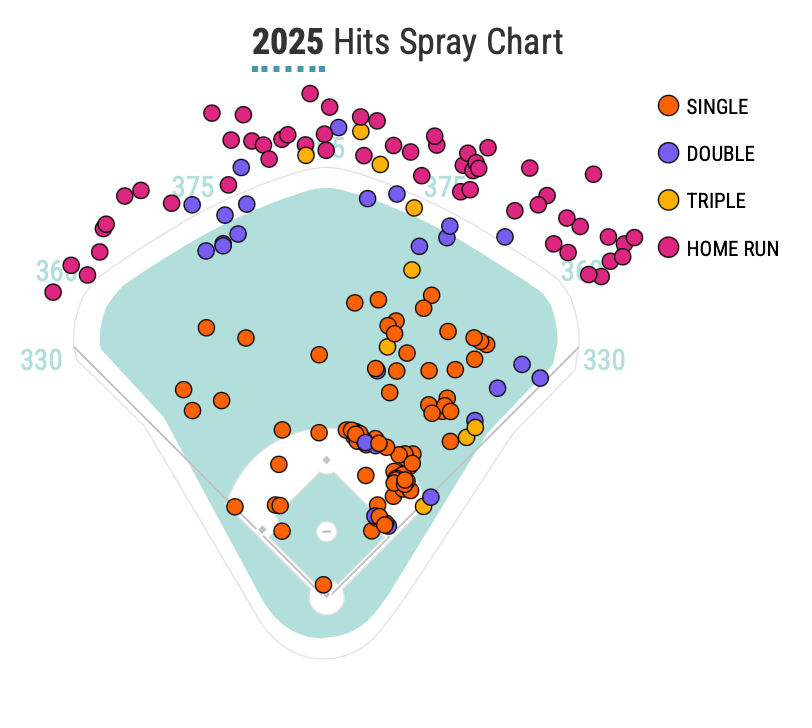
Shohei has the unique ability to hit for power all over the baseball field. Few hitters are able to do that, much less do all the rest Shohei has been known to do.
Back to his offensive results, his .418 wOBA and 172 wRC+ trailed only Aaron Judge. His .315 BABIP was well below where he would normally sit, if you could believe that, so he probably should’ve hit for a higher average. As I mentioned, that didn’t stop him from getting on base, as he managed to walk 15% of the time, a rate 2.5% higher than his career average 12.5% BB%.
As a Pitcher
It was unclear if we’d see Ohtani on the mound this season after recovering from Tommy John surgery. It’s why he strictly DH’d last season. The Dodgers understandably wanted to be cautious with getting him back, especially because they had so many top tier pitchers already. Unfortunately for other teams, he did make his return to the mound in 2025.
Per Baseball-Reference:
In 14 starts and 47.0 IP: 2.87 ERA (145 ERA+), 1.90 FIP, 1.043 WHIP, 33.0 K%, 4.8 BB%
The numbers are pretty to look at.
He made his first start in mid-June and was able to get 14 starts in, never going six innings, which he did in his last start before the playoffs.
Not having pitched for so long, Ohtani immediately showed his effectiveness from the mound. His sub-3.00 ERA and sub-2.00 FIP are phenomenal. They are backed up with a 2.45 xERA and 2.45 xFIP, notably making those numbers pretty true representations of his performance. Expected stats are supposed to “normalize” the batted ball results based on launch angle and velocity, and the fact that his xERA is also so low shows that he limited those well-hit batted balls.
It’s also worth noting just how impressive a 33% K-rate and 4.8% BB% are. He struck out 62 batters of 188 faced, walking just 9 and allowing 40 hits. Those 40 hits came on a .325 BABIP, above league average.
Ohtani didn’t register as a “qualified” pitcher, a pitcher that has at least 1 IP per team game in a season; so, for a given season, he would need at least 162.0 IP to be qualified. However, his pitching numbers from Baseball Savant suggest he still performed as one of the best pitchers in baseball while he was available. He had a .214 xBA (expected batting average), a Whiff rate of 32.5%, a Barrel rate of 3.4%, and a Hard Hit rate of 30.8%. When he wasn’t able to miss bats, he missed the sweet spots.
The ability to have mild Hard Hit and Barrel rates is especially impressive because of the velocity. Ohtani was in the 95th percentile in terms of Fastball Velocity at 98.1mph average. Coming back from TJ, that’s not too bad! He pairs that fastball with the sweeper, slider, curve, sinker, cutter, and split finger. It’s a nasty arsenal led by that +9 run value four seamer.
So, it wasn’t just his performance at the plate this year. He’s back on the mound and he’s dealing. He continued to show why he earned his 4th MVP in the postseason, despite some rough patches, eventually culminating in the Dodgers’ second straight World Series title. He represents the Dodgers like Aaron Judge represents the Yankees. He’s a leader, he has fun and he’s the embodiment of respect. He’s changed not only the game of baseball, but the business trajectory of baseball.
Expect Shohei Ohtani to win another MVP or two before it’s all said and done.
Conclusion
The game of baseball is in a good place in terms of star talent. The upcoming CBA negotiations push back on the notion of baseball being in a good place, but in terms of the on-field product, baseball’s never been more fun to watch. America’s pastime is finally catching up to other sports in the facet of athleticism. We are beginning to see players that look like football players or basketball players. Science and development are changing the game and the future of players.
As we look forward to next year, we will expect both Judge and Ohtani to have the best odds at their respective league MVP awards, once again. Some may call that boring, I call it deserving. But there are a few challengers to note.
In the AL, players like 2025 runner-up Cal Raleigh of the Mariners, Bobby Witt Jr. of the Royals, or Gunnar Henderson of the Orioles will continue to pose a threat to Judge’s crown. Similarly, in the NL, Juan Soto of the Mets, Bryce Harper of the Phillies or even a guy like Geraldo Perdomo (quietly a 7.1 fWAR player) could make runs against the Japanese phenom. But that’s unlikely in my opinion.
Of course, you can’t predict baseball. If you think you can, you’re wrong. 2026 presents a new year, a fresh slate for talented players, a new mountain to climb. But mountains in the form of 6’7” Aaron Judge and 6’3” Shohei Ohtani will be hard to move.
 Inner Half