The Mets have signed a closer. No, his name is not Edwin Díaz. It’s Devin Williams.
The former Brewer and Yankee has signed a contract with the New York Mets, giving the team some stability in their rocky bullpen that is currently in the process of potentially losing its crown jewel in Díaz.
David Stearns, the President of Baseball Operations for the Mets, is very familiar with Williams from their time together in Milwaukee, and it will be interesting to see what impact this signing has on the Mets.
After a tough year in the Bronx, Devin Williams isn’t held in the same esteem as he was just a couple seasons prior. In Milwaukee, he was the best of the best, and it will remain to be seen which version of Williams the Mets get.
Contract Details:
The New York Mets have signed 31-year-old right-hand relief pitcher Devin Williams to a 3-year/$51M contract. Per MLBTradeRumors, $6M of that is a signing bonus to be paid out in $2M installments each year, and the remaining $45 will be towards annual salary. That’s $15M average annual value (AAV), but $5M each season is being deferred.
This contract size and AAV puts him right around the Tanner Scott-Dodgers contract (4yr/$72M, $18M AAV) from last offseason and behind both the Josh Hader-Astros and Edwin Díaz-Mets contract of years past ($19M and $20.4M AAV).
What the Mets are getting in Devin Williams
A former second round pick back in 2013, the right-handed Williams is coming off an ugly season with the Yankees. However, from 2020 to 2024, Williams was seen as one of top relievers in baseball.
In that span, Williams, the 2020 NL Rookie of the Year, ranked second among all qualified relievers in ERA (1.70), including his 0.33 ERA rookie season, and ranked third in FIP (2.24). His 40.8% K% ranked second, behind only Edwin Díaz.
2025 was a different story. Traded to the Yankees for veteran pitcher Nestor Cortes and young bat Caleb Durbin as a year-long rental before he was due to hit free agency, Williams pitched in 67 games and 62.0 innings to a 4.79 ERA (85 ERA+) and a 2.68 FIP (62 FIP-). Right away, heads should turn, as the disparity of Williams’ ERA and FIP (2.11) was the greatest difference in all of baseball among qualified relievers. The next closest was Griffin Jax with a difference of 1.85 and on the other end of the spectrum, Mike Vasil of the White Sox had a -2.01 difference between ERA and FIP.
Williams ranked 8th among RPs in strikeout rate (34.7% K%) and his walk rate (9.7% BB%) was actually much better than it had been in previous years (11.3% BB% career average). He’s always been a fantastic limiter of home runs, and these three outcomes (strikeouts, walks and home runs) lead directly into his strong 2.68 FIP. Williams’ expected ERA (xERA) was 3.09, significantly less again than the 4.79 actual ERA and in the 86th percentile, and his expected batting average against (xBA) was .195, good for the 95th percentile. The peripherals were there.
So what was it?
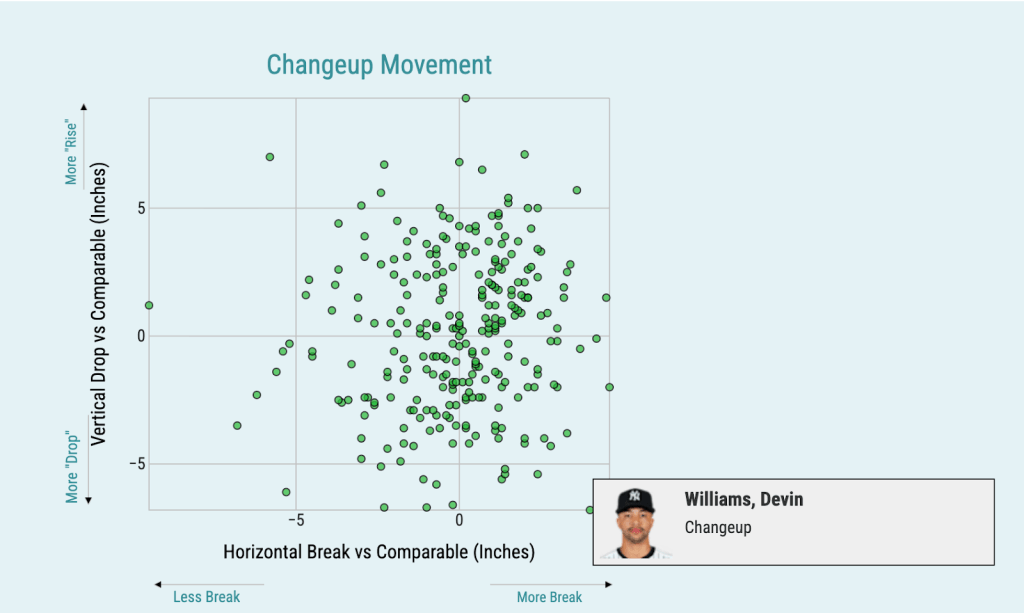
The truth is in 2025, Devin Williams was the same pitcher he’s been all his career. Primarily turning to his “Airbender” changeup, complemented by the fastball, he exhibited unique movement that few other pitchers could even dream of. The Airbender change averaged 83-84mph and with 19.2 inches arm-side horizontal break and about 5 inches of vertical drop. Spoiler: no one can throw that pitch like Williams (credit to Pitching Ninja on YouTube for the linked video).
Check out this visual below. Williams is the dot next to his image in the bottom right, which shows just how different his changeup is compared to all other changeups in baseball. The further to the right the dot, the more horizontal break versus comparable deliveries. The further down the dot, the more vertical break versus comparable deliveries.
I could talk about the changeup all day, but my point is: the “stuff” isn’t the issue.
If you watched the Yankees this year, or you check Williams’ game logs, you’ll notice a trend. A lot of the runs he allowed came in bulk.
By May 5th (14 appearances), he’d had 4 appearances where he’d allowed 3 earned runs. For a reliever pitching just one or two innings at a time, that does damage to an ERA. By the end of his Yankees tenure (62.0 IP), Williams would finish with 10 outings where he let up 2+ earned runs. Before 2025, Williams had 10 of those throughout his entire career (235.2 IP).
You have to consider the context of Devin Williams. Brought up in Milwaukee as a setup man to the great closer Josh Hader before taking over the role himself, he was efficient and nasty. Traded to the Yankees after his last appearance as a Brewer ended with Pete Alonso hitting a home run to lift the Mets over the Brewers in historic fashion in the 2024 NL Wild Card, Williams entered a free agency prove-it year with a lot of pressure on top of knowing he let up that home run. Being under pressure in the Bronx multiplies the weight of the pressure 10x. It could be that a few mistakes and mental blow-ups here and there really got to him. That is to be seen, but the Mets feel that he’s potentially gotten that out of his system.
Williams’s spot in the Mets bullpen
At the moment, Williams provides some insurance for the Mets, as they await the decision of incumbent closer Edwin Díaz in his own free agency. Díaz is the unanimous top closer on the market, and it’s likely he’ll have numerous bidders that could push the Mets to other ventures. For now, New York will trust the stuff and Williams will slot in as the Mets’ closing pitcher.
Beyond Williams, it gets a bit ugly. Two bright spots from this last year, Reed Garrett and Dedniel Núñez, underwent Tommy John surgery in July and August, keeping them out until at least late in the 2026 season. So, in front of Williams, the biggest name on the roster is lefty A.J. Minter, who is himself coming off season-ending lat surgery after throwing just 11 innings in 2025.
Lefty Brooks Raley returns after the Mets picked up his 2026 option, righty Huascar Brazobán returns and lefty Dicky Lovelady was re-signed as well.
The starting rotation will feature, in some order, Nolan McLean, Brandon Sproat, Clay Holmes, David Peterson and Sean Manaea. That is, for now it will. The Mets will likely be on the starting pitcher market as well, unless they trust in the names they’ve got. Jonah Tong could start the year in Triple-A after coming up late in 2025, or he could move to a bullpen long relief role for a time to get more acclimated to the bigs. It wouldn’t hurt for them to reach for an innings-eater with this current bullpen behind them.
I bring up the rotation because we saw this last year the Mets go for a piggy-back look at points with Clay Holmes/Sean Manaea. Like I said, Tong could come out of the ‘pen. Holmes was a reliever before the Mets turned him into a starter. So, there’s a lot of possibilities with the setup here and we’ll leave that to President of Baseball Ops David Stearns & manager Carlos Mendoza to get creative with.
What is set for now is that Devin Williams will be an impact reliever for the Mets in 2026. They’ve committed to him (more than the O’s, for example, committed to Ryan Helsley) and he’s sure to be put in some high leverage spots all year long, which they’ll be counting on him to come through for.
 Inner Half