
An October of a lifetime came via the bat of a 27-year-old Puerto Rican center fielder. A record-tying 8 postseason home runs and a record-tying 5 consecutive postseason games with a home run put the cherry on top of a 12-game stretch that can only be described as legendary. This is the story of now-Hall of Famer Carlos Beltrán’s 2004 season and its impact on baseball lore.
Up and Coming in Kansas City
From 1995 to 1997, the Puerto Rico-born Beltrán wasn’t the best hitting prospect baseball had seen, but he had a special glove in center field. At the plate, he didn’t post higher than a .723 OPS from Rookie League to High-A (A+). 1998 changed the tides a bit. He posted a .791 OPS in A+, earned a promotion to AA, and took off. In 47 games at AA, Beltrán soared with 14 HR and a 1.114 OPS. Suddenly, without so much as a cup of coffee at AAA, Beltrán was thrust into the Kansas City Royals’ big league lineup. In 63 plate appearances in the team’s final 14 games of 1998, Beltrán managed 16 hits and a .783 OPS, while seeing 14 starts in center field, one of the most important and difficult positions defensively in baseball.
1999 was Beltrán’s first season as the starting center fielder of the Royals, and performed. He took home the AL Rookie of the Year Award, showing an ability to hit for average (.293) and power (22 HR), helping him put up a .791 OPS (99 OPS+, 1% below league average 100). Not to mention, his 27 stolen bases proved that Beltrán had the looks of a 5-tool player (meaning a player that could hit for average, hit for power, run, defend, and throw).
After a disastrous, injury-riddled 2000 season, Carlos Beltrán electrified the Kansas City Royals for the next three seasons. Prior to the 2001 season, Kansas City had traded star center fielder Johnny Damon to the Oakland A’s, opening up the spot for Beltrán to take sole ownership. And that he did.
While his glove and arm in center field flourished, his bat lagged just slightly during the first half of the season. A .263/.310/.427 slash line, coupled with 11 doubles and 12 home runs preceded what would be a gigantic leap forward to close the year. With the help of a 14-game hitting streak from late-July, Beltrán exploded in August to the tune of .373/.461/.591 (1.052 OPS) with 7 doubles, 4 triples and 3 home runs. He somehow bested his August with a September to remember: 41 hits in 27 games included 9 doubles, 3 triples, and 8 home runs. His .363 batting average and .410 on-base percentage waned just slightly, while his slugging percentage stormed to .708! He was finally rounding into his 5-tool potential.
The following year, 2002, saw him play all 162 games, tallying 4.4 bWAR and posting a career-high 44 doubles, 29 home runs, 71 walks, and 35 stolen bases. The only issue was the Kansas City Royals, as an organization, did not share the same success.
A 65-97 2001 season was trumped by a 62-100 2002, the latter seeing the Royals use 3 different managers. It wasn’t until 2003 that Beltrán had a chance for a playoff run. A chance… because the Royals, who on July 17 held a 7.5 game lead in the AL Central division, played .464 baseball and went 26-30 in August-September to miss the playoffs at 83-79. Despite the disappointing back half of the Royals’ season, Beltrán managed a 9th-place finish in AL MVP voting after posting a .307/.389/.522 (.911 OPS, 132 OPS+), pumping 26 home runs, stealing 41 bases, and striking out at a career-low rate (13.5%).
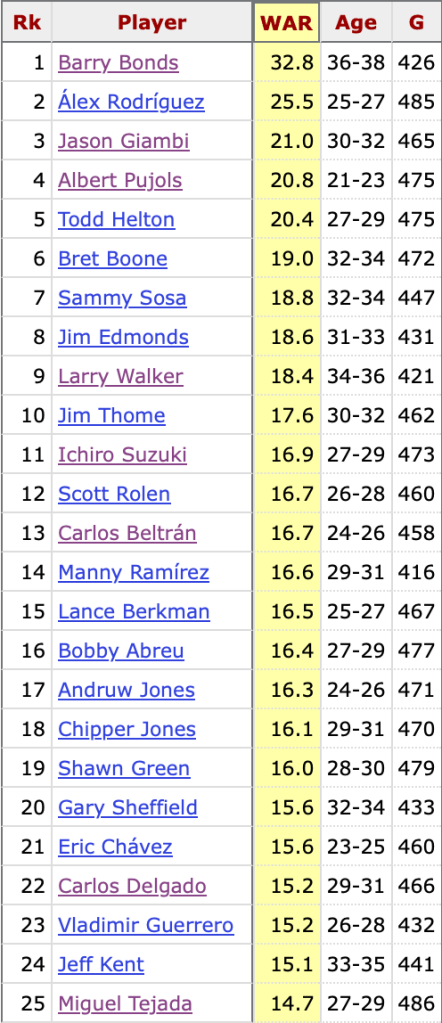
One of the more important developments of this 2001-2003 stretch was Beltrán’s availability, his ability to stay healthy and on the field. He hit at least 24 home runs, drove in at least 100 RBI, and stole at least 31 bases each season from ‘01-’03. His 16.4 bWAR ranked 13th in baseball in that time frame, proving just how valuable he was within the scope of the MLB.
As a small-market team holding one of the best, all-around young superstars in the game, the Royals were expectedly facing serious concerns in their ability to retain Beltrán going forward. He was worth more than they were able to give. Their reported final shot to lock down the switch-hitting center fielder was an offer for 3 years and $25.3 million. Scott Boras, his agent, made it be known publicly that Beltrán was seeking something more along the lines of 8-10 years and up to $200 million.
It didn’t help that Beltrán’s tenure with the Royals prior to 2004 was defined by a lot more losing than winning. Excluding his debut stretch of 14 games at the end of the 1998 season, Beltrán’s Royals had just 351 wins and 458 losses (.434 Win-Loss%). Only the Detroit Tigers (.386), the expansion team Tampa Bay Devil Rays (.394), and the Milwaukee Brewers (.419) were worse during that stretch from 1999-2003. It’s not hard to imagine that Beltrán being a part of such a poor-performing team affected the nation’s ability to watch him play. Beltrán wanted to win, and he had little opportunity to do so in the confines of Kauffman Stadium.
As a result of the chasm growing between player and organization, the soon-to-be 27-year-old Beltrán was understandably the hot commodity of the trade market. If it wasn’t already guaranteed the Royals were prepared to move him, then going 17-31 through the first 48 games and 2 months of the season solidified the notion. On one of the worst teams in baseball, Beltrán won AL Player of the Month after an April with a 1.131 OPS. It wasn’t until June 24 that the only team he’d known dealt him to the Houston Astros in a 3-team trade, in which they’d get back catcher John Buck and cash from the Astros, and pitcher John Wood and third baseman Mark Teahen from the Oakland A’s. After what Beltrán described as an emotional night of tears, he was finally a part of an organization determined to win. In fact, he wasted no time and played the next day, June 25, against the Texas Rangers, as the center fielder of the Houston Astros.
A Chance to Win in Houston
Beltrán took over center field from future-Hall-of-Famer Craig Biggio, who shifted to left field for the remainder of the season, while the ordinary left fielder Lance Berkman shifted to the right side. Those 3 outfielders combined with second baseman Jeff Kent and first baseman Jeff Bagwell, formed one of the most intimidating lineups in all of baseball. This is where everything began to change for Carlos Beltrán.
At the trade date, the Astros had just beaten the Pittsburgh Pirates to win the 4th game in their last 5, settling the team at 38-34, 5 games behind the St. Louis Cardinals (43-29), and 2 games behind the Cincinnati Reds (40-32) and the Chicago Cubs (40-32).
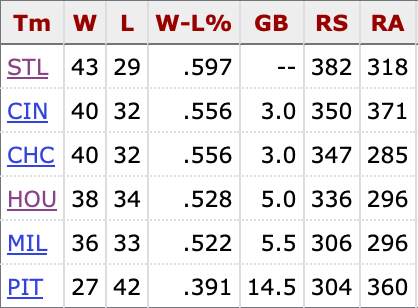
NL Central standings, as of June 24, 2004, taken from Baseball-Reference.
Houston had to step on the gas, else they risked falling out of the race due to the amount of teams making a run for October baseball. Immediately after trading for Beltrán and loading their already-strong lineup, they didn’t step on that gas. Losing 3 of the last 5 games of June and stumbling to a 12-15 July, the Astros were certainly a frustrating, confusing team. So much so, the team fired its manager, Jimy Williams, on July 15.
The team’s slip certainly wasn’t the fault of their new center fielder, who received his first All-Star nod in July 2004. Beltrán, in July, posted a .900 OPS, which included a .578 SLG due in part to the 9 home runs he hit. However, sitting at 52-52, the Astros sat 14.5 games behind the soaring Cardinals team that featured Albert Pujols, Scott Rolen and Jim Edmonds.
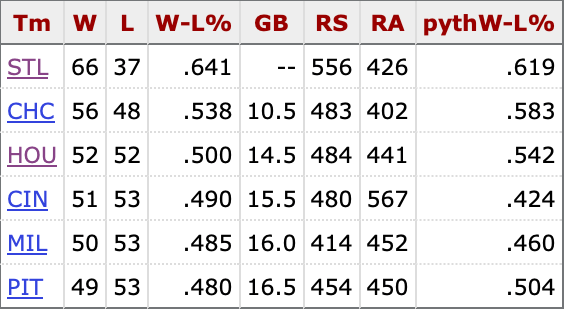
NL Central standings, as of July 31, 2004, taken from Baseball-Reference.
Houston needed to perform down the stretch. With the division title unlikely to be challenged going into the last 2 months of the season, the attention turned to the wild-card. Outside of the three division winners, the team with the best record earned a wild-card berth into the MLB playoffs. So, 6 games behind the San Diego Padres, the Astros needed a hot start to August to entrench themselves in the race.
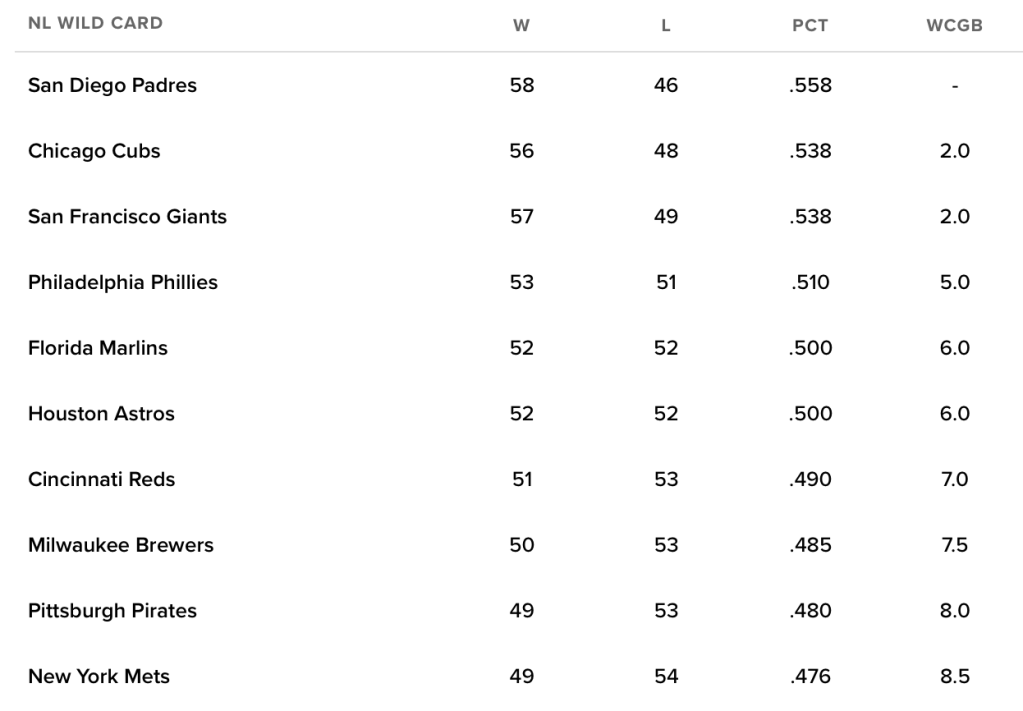
NL Wild Card race, as of July 31, 2004, taken from MLB.com.
August was a tale of two halves for Beltrán, and for the Astros. The 13-game stretch (5-8 team record) in the first half of the month saw a Beltrán slash line of .170/.316/.383, a .699 OPS. The second half (12-3) helped put the team back on the map in a big way. Beltrán made a huge impact, slashing .333/.464/.815 for a 1.279 OPS and a 215 wRC+. In 15 games, he recorded 18 hits, 12 walks to just 7 strikeouts, and 10 stolen bases. He truly did it all on offense.
It wasn’t just him, either. As a team, the Astros scored 111 runs in the second half of August, 17 more than the next-best team, the division foe and fellow wild card-contender Chicago Cubs. Along with Beltrán, Jeff Kent (172 wRC+), Lance Berkman (169 wRC+), Jeff Bagwell (155 wRC+) and Craig Biggio (133 wRC+) led one of the most fearsome lineups in the league on a torrent, and helped their team get within 3 games of a wild-card spot in a race that featured 5 teams for just 2 spots.
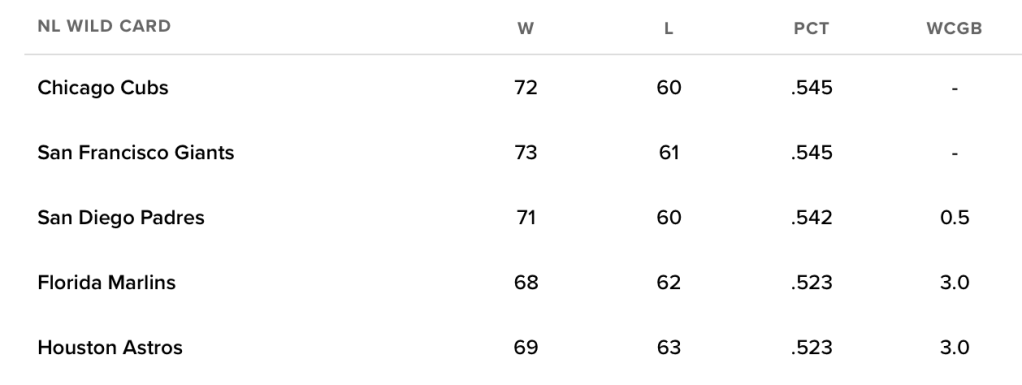
NL Wild Card race, as of August 31, 2004, taken from MLB.com.
With September teed up to be a race to the finish for the wild-card playoff berth, Beltrán and the Astros took advantage of being the chaser, as opposed to being the chased. The Astros would win 8 of their first 9 games in September and 9 of their last 10 games to finish 92-70, earning the wild card berth for the National League and the first taste of real October baseball for Carlos Beltrán. Beltrán once again proved his value at the plate when he hit 4 doubles and 6 triples in the month of September. It would be nothing compared to October.
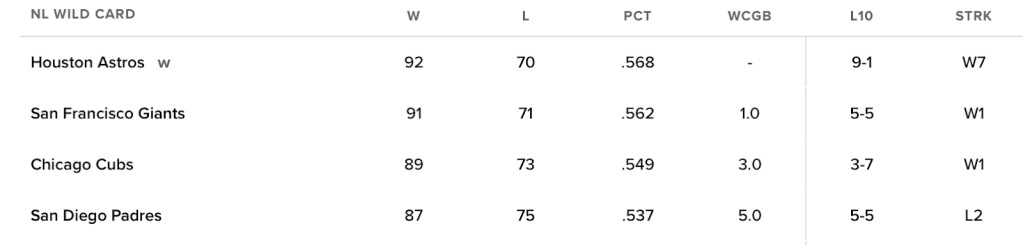
NL Wild Card final standings, as of October 3, 2004, taken from MLB.com.
An October for the Ages
October 2004 began with the National League Division Series featuring the Astros and the Braves.
In a star-studded showdown, Carlos Beltrán rose above all and delivered a final statline straight out of a video game: .455/.500/1.091 (1.591 OPS) with 4 home runs, totaling a 300 wRC+. He delivered 10 hits in 5 games, despite going 0-5 in Game 2. Perhaps most importantly at the time, in the do-or-die Game 5, Beltrán hit two home runs off Braves starter Jaret Wright, solidifying himself as a monster in the middle of the “Killer Bs” Houston Astros lineup.
After taking down the Braves in a dramatic NLDS, the Astros were faced with the toughest possible test: the St. Louis Cardinals. This Cardinals team was a force all season, going 105-57. This National League Championship Series is perhaps victim to the absurdity happening on the American League side at the time: the Boston Red Sox overcoming a 3-0 series deficit to the New York Yankees to eventually win their first World Series since 1918.
Anyhow, this series was defined by constant tension of who would come out victorious, as both teams traded wins, pulling the pennant from each other like a game of tug-of-war. What remained constant, however, was Beltrán’s dominance. He homered in four consecutive games to begin the series, bringing his postseason total to 8, tying the previous record. He also tied a record with 5 consecutive postseason games with a home run. He was building on an already-historic postseason run.
After dropping the first two games, the Astros stormed back with 3 victories to come within one win of the World Series. They seemed to have all the momentum after a Jeff Kent three-run, walk-off home run off Cardinals’ star closer Jason Isringhausen. A Jim Edmonds walk-off in Game 6 followed by a crushing Game 7 loss, thanks in large part to a 3-run Scott Rolen blast off Roger Clemens, sent the Astros packing, and ended Beltrán’s tenure there. He did not go quietly, though. In that NLCS he posted a .417/.563/.958 slash line with 10 hits, including 4 home runs and 5 RBI, soaring to a 272 wRC+. He walked 8 times to just 4 strikeouts and stole 4 bases.
What Carlos Beltrán’s 2004 Means for Baseball
Perhaps just a chapter in a memorable career, Beltrán’s 2004 stands as the gold standard for a trade deadline rental, a player acquired with impending free agency after the season with the hopes of contributing to a postseason run. Trading for rentals can be a high-risk, high-reward game baseball executives play. A lot of the time, the reward isn’t worth the risk. Think about the Beltrán trade: they made a run, but they still didn’t win it all. Teams must understand if their team is good enough even before making the trade to be a real contender in October. Postseason baseball can be a coin flip, but having 2004 Carlos Beltrán on your team sure does help.
His 2004 postseason batting line read as follows: .435/.536/1.022 (1.557 OPS), 8 HR, 14 RBI, 284 wRC+, 6 stolen bases.
A simply unfathomable statline as it is, it’s worth noting that he also tied the record for postseason home runs (8) and consecutive postseason games with a home run (5).
What does this mean in baseball history?
Well, it’s a perfect example of a small-market superstar finally making the main stage and gaining national recognition. In Kansas City, Beltrán stood no chance to showcase his abilities like he did in Houston. We continue to see this occur in modern-day baseball, teams trying to capitalize on the relative mystique of small-market players and making them superstars on the big stages.
It also shows that talent exists no matter if it’s rewarded or not. What I mean by this is Beltrán’s postseason will live on forever, whether they won the World Series or not. The same goes for MVP awards, Cy Young Awards, Gold Gloves, etcetera. Baseball history is full of “how did this guy not win this award?” seasons. There’s no one who can change the results, so it’s only worth appreciating the definite history that was made. In this case, the legend that was displayed in a Houston Astros #15 jersey in October of 2004.
 Inner Half