Behind the inflated ERA, Williams’ underlying metrics paint a more promising picture
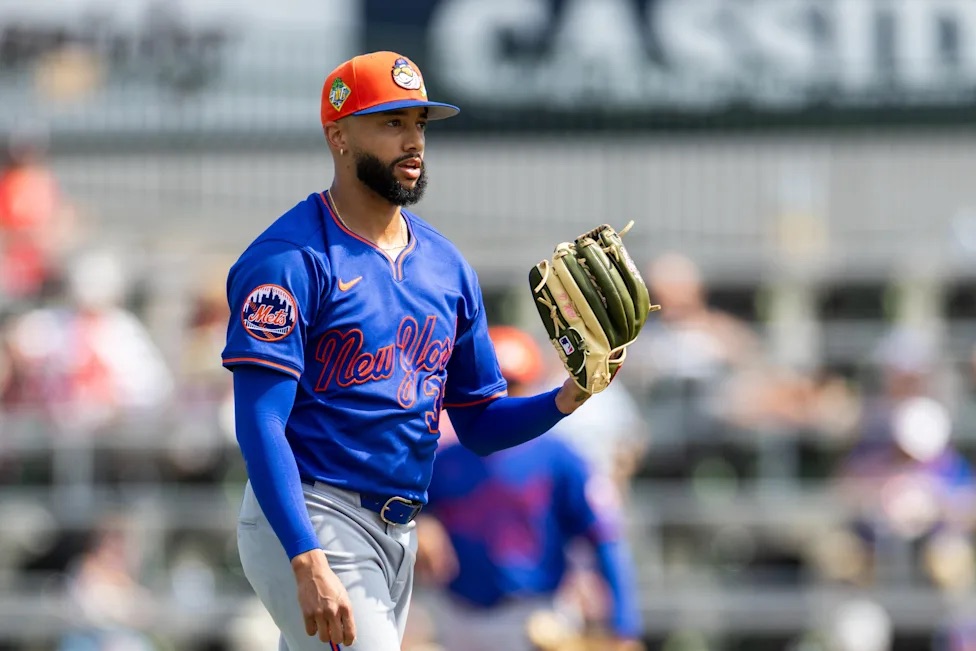
In the 4 seasons from 2020 to 2023, there may not have been a better relief pitcher in baseball than Devin Williams of the Milwaukee Brewers.
2020 was a weird year, given the COVID-shortened season and the empty ballparks, but Devin Williams made it memorable for performance reasons. Despite it being an abbreviated season, Williams still threw 27 innings to a 0.33 ERA. No, that’s not a typo. He was nothing short of legendary. He would go on to win Rookie of the Year honors in the National League (NL), becoming the first relief pitcher since Craig Kimbrel (in 2011) to win the award.
In the aforementioned 4-year span, Williams threw 200.1 innings to a 1.75 ERA. That mark was the best among qualified relievers in that span, beating out fellow relief aces like Félix Bautista (1.85) and Emmanuel Clase (1.97). He struck out 323 batters, giving him a 40.5% strikeout rate, which was second in baseball behind Edwin Díaz (42.7% K%), and held opposing hitters to a league-best .145 batting average against him.
What’s crazy is that he wasn’t the Brewers’ most coveted bullpen piece until the team traded away one of the game’s premier closers in Josh Hader to the Padres midseason in 2022. A head scratcher at the time, the deal allowed Williams to step up as the guy in the Brewers’ bullpen. He’d go on to save 65 games for Milwaukee over the next 2.5 seasons, including 36 in 2023, when he was awarded NL Reliever of the Year.
Williams then dealt with an injury-riddled 2024 season. In the offseason, he was traded to the Yankees, where he trudged through a disappointing 2025. After reaching free agency following 2025, the New York Mets scooped him up on a 3-year contract that will pay him $51 million through the 2028 season.
Now he’s 31, nearly 32. He’s coming off consecutive seasons with inflated ERAs (4.79 in 2025 w/ NYY and 4.66 in 2026 w/ NYM) and is, in all likelihood, out for the remainder of this current season with a right shoulder strain. Things have been better for the man.
Why has there been a decline in results?
Baseball’s a sick, twisted sport that proves time and time again that nothing can be predicted, no matter the data attached to it. What can be predicted with near certainty is that all players will decline as they age (aside from outliers or superhumans like Ohtani).
Devin Williams aged just like the rest of us. He’s no longer that 25-year-old kid that was striking out half the batters he faced. I can say this because the data tells us that. His four-seam fastball velocity has dropped from 96.5mph his rookie year to 93.9mph this season. His strikeout rate this season is 28.7%, compared to a career 38.4% rate coming into the season. His 39.6% groundball rate is about 6.5% lower than his career average, and is just 33rd percentile in baseball this year. Finally, he’d always had great results with runners on base, in the high leverage moments, but this season he’s allowed hitters to hit .256 with a .766 OPS against him in those situations. That leads directly to run allowance.
Shouldn’t the Mets have seen this coming? Why did Williams still earn a 3-year contract this winter? Despite a career-worst season with the Yankees, the Mets felt there was significant potential for bounceback in Williams’ performance.
The reason they believed this was because Williams’ actual results were significantly different from his expected results. In 2025, he held an actual ERA of 4.79 and an expected ERA (xERA) of 3.02. The +1.77 difference between the two was the 7th-largest difference in baseball last season. MLB defines xERA as “a simple 1:1 translation of Expected Weighted On-Base Average (xwOBA), converted to the ERA scale.” Don’t worry about what all of that means. Instead, just remember that if a pitcher has a great xERA, it means they are probably suppressing hard contact, striking guys out, and not walking guys a ton. In short, he was pitching better than his 4.79 ERA suggested.
Then the trend continued as a Met in 2026. His 4.66 ERA is over a 1.3 runs higher than his 3.30 xERA. So that’s 2 consecutive seasons of significant difference. The rest of his career prior to 2025 didn’t feature any significant difference in this particular direction. From 2020 to 2024, Williams held ERAs that were lower than his xERAs:
- 2020: 0.33 ERA | 1.42 xERA
- 2021: 2.50 ERA | 2.83 xERA
- 2022: 1.93 ERA | 2.05 xERA
- 2023: 1.53 ERA | 2.69 xERA
- 2024: 1.25 ERA | 2.10 xERA
Interesting. So, why does that ERA/xERA gap exist in ‘25 and ‘26?
In the simplest terms, it’s a combination of Williams not getting it done with runners on base and the poorly-rated defenses behind him. Let me explain.
As I mentioned, Williams began his career and saw the most success with the Brewers, an organization that prides itself on fundamental baseball on both sides of the ball. If you take a look at Williams’ team defensive rankings over the years by Outs Above Average (OAA), the difference is apparent enough:
- 2020 Brewers: +3 OAA (tied 13th in MLB)
- 2021 Brewers: -20 OAA (23rd in MLB)
- 2022 Brewers: +5 OAA (13th in MLB)
- 2023 Brewers: +38 OAA (1st in MLB)
- 2024 Brewers: +29 OAA (3rd in MLB)
- 2025 Yankees: -7 OAA (tied 18th in MLB)
- 2026 Mets: -19 OAA (24th in MLB)
Outside of 2021, his time with the Brewers was spent with solid and elite defensive fielding behind him. While pitching for both New York clubs, his clubs have been in the bottom half of the league. Grading defensive play through statistics like OAA is the least understood facet of baseball’s sabermetrics, so don’t take it as gospel, but it’s worth something.
To support that, Williams’ batted-ball data tells us he’s been hurt by his defense. He has a hard-hit rate in the top 5 percent of baseball, so he’s generating a lot of softer contact. His .277 batting average against is 58 points higher than his .219 expected batting average against (xBA). That’s the 2nd-largest gap in baseball. His .394 slugging percentage against is 84 points higher than his .310 expected slugging percentage against (xSLG). That’s the 9th-biggest gap, and the .310 xSLG is among the top 10% in baseball, by the way. Lastly, his .338 wOBA is 56 points higher than his .282 expected wOBA (xwOBA). That’s the 3rd-biggest gap. Again, don’t feel the need to know what wOBA means. Just know that these are significant gaps and should be seen as a positive sign for Devin Williams.
More important than the defense, in my opinion, is the utter collapse of his left on-base percentage (LOB%). When a pitcher is said to leave runner(s) on base, per MLB’s glossary, “it refers to the number of men who remain on base at the end of an inning.” If Williams gets the third out of the inning with runners still on first and second base, he left 2 runners on base. That is the meat of LOB%, the rate at which a pitcher leaves runners on base when he has them on base. Take a look at Williams’ LOB% through the years:
- 2020: 84.3%
- 2021: 83.1%
- 2022: 76.8%
- 2023: 85.0%
- 2024: 92.6%
- 2025: 55.2% (LAST in MLB)
- 2026: 65.2%
From 2020 to 2024, Williams sported the 6th-best LOB% in baseball. Then in 2025, he had literally the worst LOB% in baseball. How insane is that? It’s such a drastic drop-off, one has to believe it to be an outlier of a season, but the trend has also somewhat continued in 2026. Hitters have a .766 OPS against Williams with runners on base this season, much worse than the .611 OPS career mark in those situations. Williams may have simply lost something in those high-leverage moments. Whether it’s the bright lights of New York or just happenstance will likely never be fully understood. However, it’s my belief that the defense and the performance with runners on base have been primary drivers to his inflated ERA the last two seasons.
My Take
Now that I’ve thrown all this information at you, I can conclude with my opinion: Devin Williams is still Devin Williams. Sure, he’s a little older, throws a little less hard, and has a real price tag to live up to under a New York City magnifying glass. Let me tell you why I came to this conclusion.
Devin Williams isn’t pitching the way he should be. His go-to, signature pitch has always been his changeup. The pitch is so unique that it earned itself the nickname “Airbender.” Take a look at the following visual:
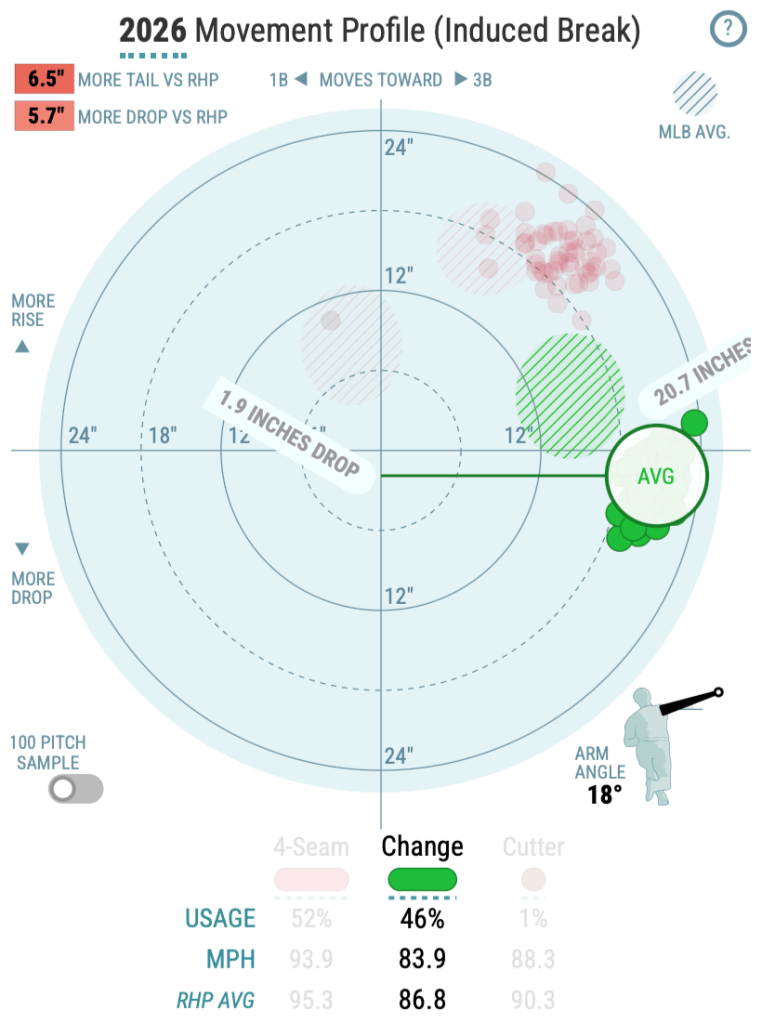
The shaded green circle is the average amount of movement on right–handed pitchers’ changeups across MLB. The grey circle with “AVG” is the average Airbender changeup movement profile. It’s such an elite complement to his four-seam fastball that it’s got him to this point of his career. He’s racked up strikeouts and consistently gotten groundballs (instead of flyballs) as a result of the two-pitch pair.
At his peak, Williams was throwing the changeup more often than his fastball. Understandably so – it was one of the best pitches in all of baseball. Here’s his changeup usage over the years, coupled with the expected wOBA (xwOBA) against it:
- 2020: 52.7% changeup | .108 xwOBA
- 2021: 63.8% changeup | .210 xwOBA
- 2022: 58.1% changeup | .228 xwOBA
- 2023: 57.9% changeup | .231 xwOBA
- 2024: 45% changeup | .210 xwOBA (limited IP sample)
- 2025: 52.4% changeup | .278 xwOBA
- 2026: 46.3% changeup | .247 xwOBA
The .247 xwOBA in 2026, although not at the levels of years past, tells us that the changeup is still really effective and difficult for opposing hitters to make solid contact with. The hard-hit rate against it is 4th-best among pitchers who have thrown 300+ changeups, and it’s got the 11th-best rate of swings-and-misses, aka whiff rate.
The fastball being used more is something that just can’t happen. I mentioned it’s lost velocity over the years and, additionally, the .329 xwOBA against the fastball tells us hitters make better contact against it than against his changeup. His pitch mix and usage simply is not optimal this year. There’s room for adjustment and, in turn, improvement.
So to wrap it up, he’s still good. I’m constantly coming across keyboard warriors blabbering online that Williams “sucks” or is “washed,” but they only look at results. At the end of the day, they’re only watching the pitcher face the batter, and aren’t necessarily taking into account the greater context. With the right adjustments in pitch usage, better defensive performance behind him, and some sharper execution with runners on base, Williams can begin to resemble the dominant young arm he was in his Milwaukee days. Albeit just a little bit older and throwing a little less hard.
 Inner Half