WAR. Wins Above Replacement. It’s such a hotly debated topic in the baseball world. Some love it and some hate it, but it’s a cornerstone of baseball player evaluation in today’s landscape. It turns a ton of the data we track into one clean, simple number. Nice to have, right? Allow me to explain why it’s so divisive.
What is WAR?
WAR stands for Wins Above Replacement. Before we do anything else, we have to define “Replacement” because the value of “Wins” stems from this baseline level. Replacement level, in the simplest terms, is the level at which a Minor Leaguer or a readily-available fill-in player might perform in that league at his same position. Think of it as “just an okay player.”
WAR encompasses several facets of the game of baseball to determine a player’s value relative to this “just okay player.” It works on both the position player and the pitcher side. Let’s start with position players.
For position players, we’re talking about the most obvious stuff like hitting, baserunning and fielding. This means a player will generally gain more WAR if they hit well in relation to league average and if they make an impact on the basepaths. WAR is also impacted by the defensive position one plays. It’s common practice to weigh defensive ability at shortstop greater than defensive ability at first base, for example. As a result, great defensive shortstops will be rewarded on WAR’s scale, even if their offense lags. The general consensus of defensive position value favors “up-the-middle” positions (shortstop, second base, center field, and catcher) over the “corners” (1B, 3B, LF, RF).
On a more granular level, we’re also taking into account league context. The definition or value replacement-level players may change year-over-year depending on the quality of players in the league. For now, don’t worry too much about that.
Pitcher WAR is a little more complicated and, with full transparency, I don’t pay much attention to it, but let’s talk through it. Pitcher WAR is generally calculated with factors like RA9 (think ERA, but including unearned runs), FIP (Fielding-Independent Pitching), adjustments for a pitcher’s home ballpark, adjustments for greater league offensive environment, and, finally, league averages.
The important thing to know: pitcher WAR attempts to tell us the same thing that position player WAR tells us: how valuable is this particular player in relation to a replacement-level player of the same position? For this piece, though, I’m going to stick to position player WAR.
The last thing I want to note about the specifics of WAR. There are two commonly-used versions, fWAR and bWAR. fWAR refers to FanGraphs’ WAR and bWAR refers to Baseball-Reference WAR. They are the same data point, but some of their inputs vary, leading to inconsistencies sometimes. For now, it’s not important to know what those inputs are. Instead, just be aware that those exist in case you ever come across them.
If you’re still with me now, let’s get into some examples before talking through some common misconceptions about WAR.
Same Stat, Different Stories
As I explained above, WAR treats certain defensive positions as more valuable due to the difficulty associated with playing said position. For example, a center fielder will tend to generate more WAR in relation to a first baseman. This can be seen as both a strength and a weakness of WAR. Let’s walk through some examples.
For this exercise, we’re going to use bWAR, Baseball-Reference’s version of the metric. Let’s start with taking a look at Pete Crow-Armstrong and Kyle Schwarber, two of the best hitters in the National League (NL).
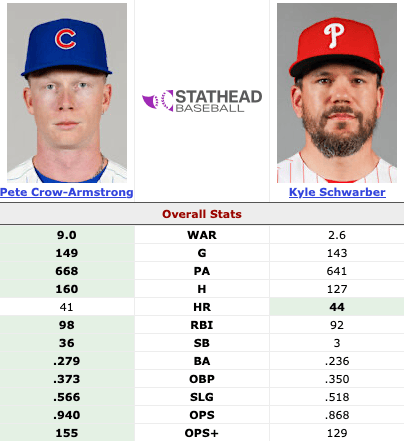
Interesting, right? PCA has Schwarber beat in a lot of categories here, but Schwarber has hit more home runs as of my writing this. These are two dominant hitters having incredible seasons. So why does Schwarber’s 2.6 bWAR pale in comparison to PCA’s 9.0? Defense. PCA is one of the best defensive center fielders in baseball and, in addition to that skill, he’s having one of the best offensive seasons around the league. He’s an extreme example, but it shows you what the upper echelon of WAR could bring. For reference, Schwarber is Philadelphia’s designated hitter and isn’t getting that defensive boost to WAR. As a result, his 2.6 WAR is attributed to his offensive domination. This WAR comparison is clearly telling us that PCA impacts the game in all areas of the game, while Schwarber’s offense, though amazing, is his game.
No one’s going to look at these two hitters and say PCA’s that much better than Schwarber. Maybe there are people who say that, but that’s not the point of WAR. The point of WAR is to estimate a player’s worth to a team in wins. Maybe a player is below league average offensively, but is an amazing defender. WAR attempts to encapsulate that in a single number. It’s dangerous to wage a war about WAR when comparing two completely different players. (You didn’t think you were getting through this without a war pun, did you?)
Let’s link back up with the familiar face of Kyle Schwarber and compare him to a completely different type of player: Taylor Walls, shortstop for the Tampa Bay Rays.
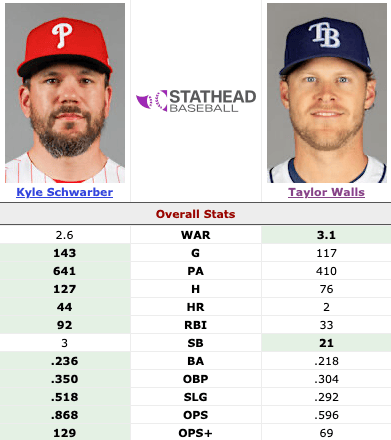
Walls’ OPS on offense is 31% below league average. Schwarber’s is 29% above league average. Yet, Walls outpaces Schwarber with 3.1 bWAR in 26 less games. This is an example of an unfair comparison. Walls plays the most demanding defensive position, and he plays it so well that he’s able to make up for his lousy offensive results. Comparing these two is comparing apples to oranges, and that is the most common misconception of WAR. It is not meant to be a complete, 100%-accurate evaluation of a player and how that player stacks up against other players. It’s simply made to show an estimation of value at a quick glance.
Also worth noting, the same rule goes for comparing players across baseball history. One cannot compare the season of Babe Ruth’s 14.1 WAR season in 1923 to Barry Bonds’ 11.9 WAR season in 2001. Those are two completely different league environments. And remember when I said there’s a “replacement level”? Well, replacement level could mean a completely different thing one year to the next, let alone 78 years apart. Anyways, something to note for the next time you’re scrolling and find someone comparing two baseball players that have no business being compared.
Why Should You Care?
Hopefully, you’re able to understand the next time someone brings up WAR, whether that’s a friend talking about PCA’s season or the broadcaster talking about a player on your favorite team. But the question I’m sure you want answered is: “Why should I care?”
You should care about WAR in addition to the many metrics that baseball players are evaluated on because it does have an impact in both active players’ contract negotiations and eventual Hall of Fame arguments for former players.
The simpler of the two is that WAR can be used as a general guideline for monetary value of a player as they enter arbitration or free agency. I won’t get too nitty-gritty, but think of it like organizations see 1 win above replacement as $8 million, for example, on the open market. That’s not the exact number, but you get the idea.
In the context of the Hall of Fame, you’ll hear a few different references to WAR. Obviously, there’s the simple philosophy that if a player racks up a historic amount of WAR, they should be considered for the Hall. For example, newly-inducted Carlos Beltran totaled 70.0 bWAR over his 20-year career. A second way the voters look at WAR is a player’s “peak” WAR. The most common peak WAR to consider is a player’s 7 year-peak WAR. Think of it as: how good was he in the best 7-year stretch of his career? Beltran’s 7 year-peak was 44.4 WAR, and according to Baseball-Reference, the average 7 year-peak is 44.8 WAR.
Wrapping it up
If you’ve made it this far, you’re a trooper. WAR is one of the more confusing and polarizing metrics of the baseball world, but it’s also one of the most referenced on a historical level. It attempts to encompass a player’s true overall value into one clean number, rather than having you self-compute their value through the consideration of various other metrics. It’s a complicated calculation for a simple purpose, and it’s not meant to be taken as gospel. But the next time you’re a few drinks in with some buddies debating all-time baseball players, start with how valuable they were to their team in the context of the league that year.
Maybe WAR… can bring peace?
 Inner Half